
In our daily lives, we are constantly confronted with various food-related challenges: recurring food safety incidents, persistent food poisoning cases, widespread dietary disorders such as overeating, restrictive dieting, and imbalanced food choices, as well as environmental crises caused by the disorderly expansion of the food industry, including resource depletion, ecological degradation, and excessive carbon emissions.
On one side there are food poisoning, ecosystem destruction, and global warming; on the other side there are dietary disorders and diet-related chronic diseases. These seemingly unrelated issues share a common origin: They are all closely linked to the way human beings acquire and utilize food.Shiology refers to these behaviors collectively as “Shiance Behavior”and many food-related challenges ultimately arise from inappropriate shiance behaviors.

Shiance Behavior is an abbreviation for “food-related behaviors”. It refers to the activities through which human beings acquire and utilize food and is one of the fundamental concepts of Shiology. It encompasses behaviors related to food production, processing, distribution, regulation, and eating.
Shiance Behavior is not limited to individual choices of what and how to eat. It also includes how societies produce, process, transport, and regulate food, as well as how human activities influence the ecological environment that sustains food production.
Obesity, malnutrition, and digestive disorders are manifestations of inappropriate shiance behaviors at the individual level, including unhealthy eating patterns and irrational food choices. Food safety risks, food waste, and industrial disorder reflect inappropriate shiance behaviors in production, processing, distribution, and regulation. Environmental challenges such as land degradation, water pollution, excessive greenhouse gas emissions, and biodiversity loss result from inappropriate shiance behaviors characterized by uncontrolled exploitation, excessive production, and wasteful consumption.
From individual health to global ecological sustainability, all food-related conflicts and crises ultimately stem from human food-related behaviors deviating from the fundamental laws governing food and life.
Human food-related behaviors must follow two essential systems: the operational laws of the food transformation system to achieve health and longevity;and the operational laws of the Food Ecological System to achieve sustainable development.These two systems complement each other and are indispensable.
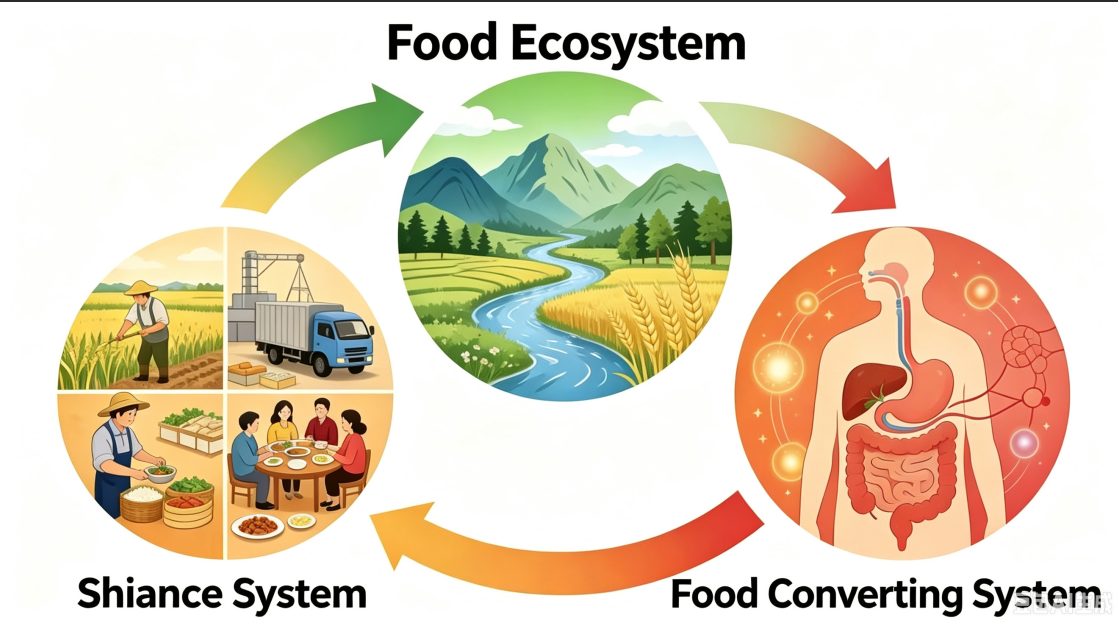
The ultimate value of food lies in its transformation within the human body—through digestion, absorption, and utilization—to provide energy and nutrients necessary for life activities.Therefore, human dietary behaviors must follow the inherent laws of the body, including nutritional requirements, metabolic processes, and physiological capacity.
However, many inappropriate shiance behavior practices disrupt this balance. Excessive eating results in energy intake exceeding bodily needs; prolonged dieting causes nutritional deficiencies; selective eating leads to nutrient imbalance; and excessive consumption of foods high in fat, sugar, and salt increases physiological burdens.
Respecting the laws of the Food Transformation System is the fundamental basis for maintaining physical and mental health.
Land, water, atmosphere, and biological resources together form the ecological foundation that supports food production. Agriculture, livestock production, food processing, and consumption all depend on ecosystems.
However, excessive exploitation, resource depletion, and disorderly utilization are weakening this foundation. Over-cultivation contributes to land degradation; excessive resource consumption disrupts ecological balance; pollution damages natural environments; and food waste places unnecessary pressure on resources.
Such inappropriate shiance behaviors not only affect current food availability but may also undermine humanity’s future ability to secure food.Following the laws of the Food Ecological System means meeting present needs while preserving the capacity to provide food for future generations.
Shiology proposes a dual governance approach to correct inappropriate Eatance. This approach combines institutional constraints and educational transformation to guide human food-related behaviors toward compliance with the operational laws of both the Food Transformation System and the Food Ecological System.

Institutional constraints refer to the regulation of social and industrial Eatance through laws, policies, and administrative measures. They are characterized by authority, enforcement, and institutionalization.To address inappropriate shiance behaviors at the public level—such as unsafe food production, illegal operations, excessive resource consumption, and food waste—it is necessary to establish and strengthen legal frameworks covering food safety, food security, and environmental protection.
Meanwhile, through market supervision, administrative enforcement, and industry oversight, violations such as illegal production, improper processing, food waste, and ecological destruction should be corrected and penalized.Institutional constraints serve as the essential safeguard. Through effective governance and accountability mechanisms, they prevent behaviors that violate natural laws and harm public interests, thereby protecting both food security and ecological security.
Educational transformation refers to correcting individual and everyday shiance behaviors through education, awareness-building, and changes in social practices.Many personal dietary disorders, everyday food waste, and misconceptions about eating are not intentional violations; rather, they result from insufficient knowledge and deeply rooted habits.
Therefore, Shiology education, public health communication, and ecological awareness initiatives are needed to help people understand dietary principles, recognize the consequences of inappropriate shiance behaviors, and develop scientific perspectives on food, nutrition, and sustainability.At the same time, traditional food practices should evolve by moving away from excessive consumption, wasteful customs, overeating, and irresponsible food choices, while promoting eating behaviors that respect life and nature.The essence of educational transformation lies in “changing behaviors through continuous influence”—fundamentally reshaping public understanding so that responsible, scientific shiance behavior becomes a conscious way of life.
From an individual’s excess body weight, to food safety vulnerabilities within industries, to global challenges such as climate change and ecological degradation, all these issues are closely connected with human food-related behaviors.Only by respecting the operational laws of the Food Transformation System and the Food Ecological System, and by regulating human shiance behaviors through a balanced governance approach combining institutional constraints and educational transformation, can we achieve a shared future of individual health, social stability, and ecological sustainability.
Contact Person: Mr Zhang E-mail: Secretariat@shiology.world